Crepe batter shelf-life guide
How Long Does Crepe Batter Last? Fridge, Counter and Freezer
Classic crepe batter made with eggs and milk is best used within 24 hours and should generally not be kept longer than 48 hours in the refrigerator. At room temperature, the safe window is much shorter. The batter may separate or thicken while still usable, so storage time and temperature matter more than appearance alone.

Quick answer
Use refrigerated crepe batter within 24–48 hours and keep it at or below 40°F (4°C). Food Network recipes by Alton Brown and Anne Burrell explicitly allow up to 48 hours, while overnight use gives the most predictable quality. Do not leave egg-and-milk batter at room temperature for more than about two hours. For longer storage, cook and freeze the crepes.
Crepe Batter Shelf Life at a Glance
| Storage condition | Practical limit | Expected quality | Best decision |
|---|---|---|---|
| Room temperature | Up to about 2 hours | Good during a planned rest | Cook or refrigerate promptly |
| Refrigerated under 24 hours | Best window | Hydrated, smoother, may thicken slightly | Stir and cook |
| Refrigerated 24–48 hours | Outer common limit | Usable but more separation likely | Assess storage history and cook soon |
| Refrigerated beyond 48 hours | Not recommended | Declining quality and increasing uncertainty | Discard |
| Frozen raw batter | Recipe-dependent | May separate after thawing | Freeze cooked crepes instead |
How Long Does Crepe Batter Last in the Fridge?
Major sources cluster around one to two days. Alton Brown's Food Network recipe says the batter keeps up to 48 hours, and Anne Burrell's version uses the same limit. King Arthur's buckwheat and teff recipes explicitly refrigerate batter for at least two hours or overnight.
That creates a practical distinction:
- Overnight: the strongest quality target.
- Up to 24 hours: very practical for make-ahead cooking.
- 24–48 hours: an outer recipe-supported window.
- Beyond 48 hours: not a good general recommendation.
The batter should remain covered and consistently cold. The door of the refrigerator is less stable than the main compartment.
How Long Can Crepe Batter Sit Out?
A short room-temperature rest can be part of a recipe, but crepe batter often contains raw eggs and milk. Do not leave it on the counter for more than about two hours in total, or more than one hour when the room is hotter than 90°F (32°C).
Count all warm time together: mixing, resting, sitting beside the stove and waiting between batches. Refrigeration does not reset a batter that has already spent too long warm.
How Batter Type Changes Shelf Life and Quality
| Batter type | Refrigerator outlook | Expected change | Best practice |
|---|---|---|---|
| Classic wheat, egg and milk | 24–48 hours | Separation and mild thickening | Stir before use |
| Buckwheat | Often designed for overnight rest | Strong hydration | Thin with water if the recipe directs |
| Teff / gluten-free | Recipe-dependent | Can become much thicker | Follow the blend-specific formula |
| Dairy-free with plant milk | Usually similar to classic batter | Plant milk may separate | Recombine gently |
| Vegan flax or chia batter | Short storage preferred | Binder continues gelling | Adjust liquid cautiously |
| Beer batter | Recipe-dependent | Carbonation fades | Do not expect fresh fizz after storage |
| Whipped egg-white batter | Poor long-term stability | Foam collapses | Fold whites shortly before cooking |
Normal Changes That Do Not Automatically Mean Spoilage
Separation
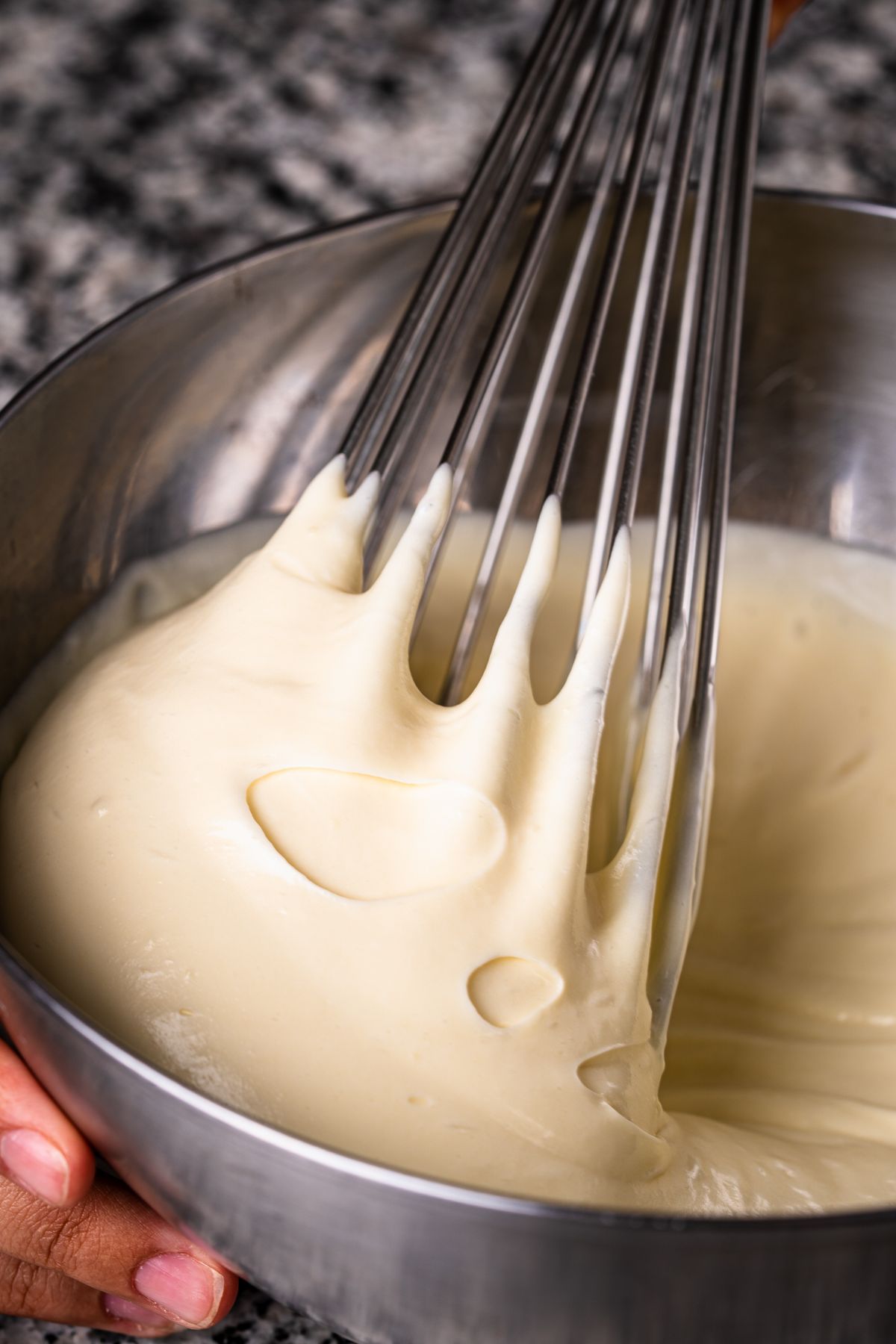
Flour settles, liquid rises and butter may firm. Stir or briefly blend.
Thickening
Flour continues absorbing liquid. Add milk or water gradually.
Small surface bubbles
Can result from mixing. Large unexplained gas after long storage is different.
Slight color shift
Minor oxidation can occur, but unusual pink or green patches are not normal.
Food Network Kitchen recommends re-blending rested batter to reincorporate separated ingredients and promote even browning. King Arthur's buckwheat and teff formulas specifically add water after resting because those flours absorb more liquid.
How to Tell If Crepe Batter Has Gone Bad
- Visible mold or fuzzy growth.
- Pink, green, orange or black discoloration.
- A rotten or unexpectedly strong sour odor.
- A swollen container or active gas not explained by yeast.
- An unknown storage date.
- More than 48 hours in the refrigerator.
- Extended time above refrigerator temperature.
How to Store Crepe Batter for the Longest Useful Life
- Transfer it to a clean airtight container.
- Leave enough space to stir or shake it later.
- Label the container with the mixing date and time.
- Store it in the main refrigerator compartment.
- Keep the refrigerator at or below 40°F (4°C).
- Use the batter within 24 hours when possible.
- Treat 48 hours as the outer limit.
A sealable jug is convenient for pouring, but a wide bowl is easier to inspect and stir. Choose the container that best fits the recipe and your ability to clean it thoroughly.
How to Use Crepe Batter Near the End of Its Storage Window
- Check the date and temperature history.
- Inspect for mold, odd color or unexpected odor.
- Stir or briefly blend until smooth.
- Compare the consistency with light cream.
- Add milk or water one tablespoon at a time if too thick.
- Cook one test crepe.
- Adjust pan heat or batter thickness only after the test.
| What happens | Likely reason | Best adjustment |
|---|---|---|
| Batter will not spread | Continued hydration | Add liquid gradually |
| Crepe tears | Pan too cool, undercooking or thin batter | Calibrate with a test crepe |
| Uneven greasy spots | Butter separated | Blend briefly |
| Many holes appear | Batter was over-aerated | Rest briefly after blending |
| Edges brown too fast | Pan too hot or sweet batter | Lower heat |
| Batter smells questionable | Possible spoilage | Discard; do not troubleshoot |

Can You Freeze Crepe Batter?
Some secondary storage guides recommend freezing batter, but major recipe sources more consistently support short refrigerator storage and freezing the cooked crepes.
Cooked crepes are usually the better freezer product because:
- the finished texture is already set;
- they can be separated into portions;
- they thaw quickly;
- they can be reheated directly;
- there is no need to remix and cook later.
Use refrigerator storage for batter needed tomorrow. For longer storage, cook the batter and follow the dedicated guide on freezing crepes.
Crepe Batter vs Cooked Crepes: Which Lasts Better?
| Priority | Better choice | Why |
|---|---|---|
| Fresh crepes tomorrow | Refrigerated batter | Cooked to order |
| Breakfast later this week | Cooked refrigerated crepes | Less safety uncertainty |
| Storage for several weeks | Frozen cooked crepes | Better portioning and reheating |
| Best make-ahead workflow | Overnight batter | Rest improves hydration |
| Least morning work | Cooked crepes | Only reheating is required |
Crepe Batter Shelf-Life Troubleshooting
| Situation | Best decision |
|---|---|
| Mixed last night and stayed cold | Stir, adjust consistency and cook |
| Mixed two days ago and reliably refrigerated | Use immediately if no spoilage signs |
| Older than 48 hours | Discard |
| Sat out for three hours | Discard |
| Separated but smells normal | Stir or blend; separation is common |
| Pink patch or mold | Discard immediately |
| Very thick buckwheat batter | Thin according to the recipe |
| Storage date is unknown | Discard rather than guess |
Frequently Asked Questions
How long does crepe batter last in the fridge?
Most classic crepe batter should be used within 24 to 48 hours when stored covered at 40°F (4°C) or below. Several Food Network recipes specifically allow up to 48 hours.
How long can crepe batter sit out?
Raw batter containing eggs and milk should not remain at room temperature for more than about two hours, or one hour in temperatures above 90°F (32°C). A shorter recipe-directed rest is acceptable.
How can you tell if crepe batter has gone bad?
Discard batter with mold, pink or green discoloration, a rotten or unexpectedly strong sour odor, unexplained gas or an uncertain storage history. Do not taste raw batter to test it.
Can crepe batter last three days in the fridge?
Some secondary sources suggest three days, but major recipe sources commonly support 24 to 48 hours. A two-day maximum is the more conservative general recommendation.
Is it better to freeze crepe batter or cooked crepes?
Cooked crepes are usually easier to portion, freeze and reheat. Refrigerate batter for short make-ahead storage and freeze the finished crepes for longer storage.
Why does crepe batter separate in the fridge?
Flour settles, liquid rises and melted butter can firm during storage. Stir or briefly blend the batter before cooking.
Why is refrigerated crepe batter thicker?
Flour continues absorbing liquid while it rests. Add milk or water gradually until it again coats the pan in a thin layer.
Bottom Line
Use crepe batter within 24 hours for the best result and no later than about 48 hours in the refrigerator. Keep it covered and cold, and do not leave it at room temperature beyond a short planned rest.
Normal separation and thickening can usually be corrected. Mold, unusual color, bad odor, unknown storage or more than two days in the refrigerator are reasons to discard it. For longer storage, cook and freeze the crepes rather than keeping raw batter.