Leftover waffle field guide
How to Reheat Waffles: The Best Method for Crispy Results
The best reheating method depends on how many waffles you have, whether they are refrigerated or frozen, and how thick they are. Use a toaster for one or two thin waffles, an oven for a batch, an air fryer for a few thick waffles, and the microwave only when speed matters more than crust.

Quick answer
For one or two waffles, reheat them in a toaster on a low-to-medium setting and check before a second cycle. For several waffles, arrange them in one layer in a 350°F (175°C) oven for roughly 5–10 minutes. For thick Belgian waffles or a small batch, use an air fryer around 350°F for about 2–5 minutes. You normally do not need to thaw frozen waffles first.
Choose the Best Reheating Method
Most competing guides list appliances one after another. A faster decision starts with portion size and desired texture.
| Your situation | Best method | Starting point | Main tradeoff |
|---|---|---|---|
| One thin waffle | Toaster | Low-to-medium setting, one cycle | Can burn quickly on a high setting |
| One thick Belgian waffle | Toaster oven or air fryer | 325–350°F, check after 3 minutes | Needs center heat without overdarkening edges |
| Two to four waffles | Air fryer or toaster oven | 350°F, roughly 2–5 minutes | Air fryer capacity may be limited |
| Family-size batch | Conventional oven | 350°F, roughly 5–10 minutes | Slower because of preheating |
| Frozen commercial waffle | Toaster | Use a conservative setting and repeat if needed | Exact time varies by thickness and toaster |
| Frozen homemade Belgian waffle | Toaster oven or oven | Moderate heat until center is hot | Too much high heat can darken the outside first |
| Waffle is already dry | Skillet with a little butter or brief microwave + toaster | Gentle heat | Added moisture/fat changes original texture |
| You have under one minute | Microwave | Short burst | Soft rather than crisp |
Best for One or Two: Reheat Waffles in a Toaster
Pantry & Larder compared six reheating methods and selected the toaster as its favorite, using a high setting for roughly one to two minutes in its specific test. Food Network also calls the toaster the quickest method for frozen homemade waffles, but recommends a low setting and repeated doneness checks because the margin between crisp and burnt can be narrow.
Those instructions are not contradictory: toaster power and waffle thickness vary. A safer universal approach is to start lower than you think you need, inspect the waffle, then add a second short cycle if the center is still cool.
Use a waffle that fits safely
Do not force an oversized Belgian waffle into a narrow slot. Break a frozen segmented waffle only when it is designed to separate cleanly, or use a toaster oven instead.
Choose a low-to-medium setting
You can always repeat the cycle. You cannot undo a scorched exterior.
Check the center
The grid can feel crisp before the middle is fully warm. Thick waffles may require a second cycle at a lower setting.
Serve immediately
Do not cover or stack the waffles after toasting; trapped steam begins softening the surface.
When the toaster is not the right choice
Skip an upright toaster when the waffle is too thick, covered with sticky toppings, broken into small pieces that could fall inside, or likely to release melted cheese or other ingredients into the slots.
Best for a Batch: Reheat Waffles in the Oven
An oven is the practical choice when everyone needs to eat at the same time. Several current guides use 350°F (175°C) as a moderate reheating temperature, while Food Network gives a hotter, shorter method for frozen homemade waffles: loosely wrapped at 425°F for about five minutes for flat waffles and seven to eight minutes for Belgian waffles.
Because those approaches target different balances of speed, moisture and crispness, this guide uses 350°F as the more forgiving default. Increase the temperature only when you already know how your waffles behave.
Preheat to 350°F (175°C)
Starting in a cold oven lengthens the drying period and makes timing less predictable.
Arrange waffles in one layer
Put them directly on an oven rack for maximum airflow, or on a sheet pan or wire rack for easier handling. Avoid overlap.
Heat for roughly 5–10 minutes
Thin refrigerated waffles will be ready near the low end. Thick or frozen waffles can require longer.
Check the center before serving
Do not judge only by edge crispness. A Belgian waffle has more interior mass to warm.
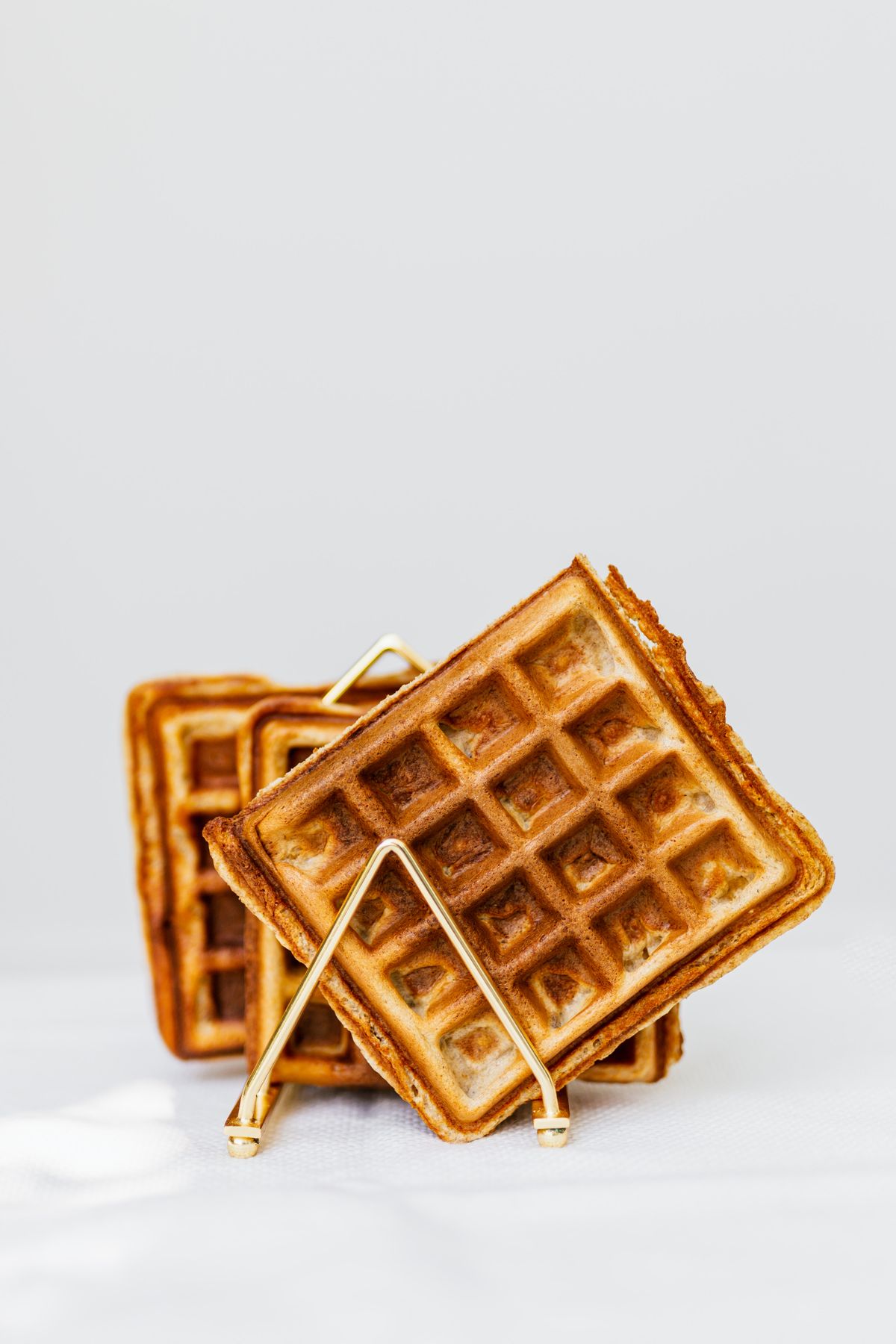
Best for a Few Thick Waffles: Use the Air Fryer
Air fryers circulate hot air aggressively, which can restore a dry, crisp surface quickly. A current Chef's Resource guide recommends about 350°F (175°C), with roughly one to two minutes for refrigerated waffles, two to three minutes for thin frozen waffles and four to five minutes for thick Belgian waffles.
Those figures are useful starting points, not fixed rules. Pantry & Larder's direct comparison found that its air-fried waffle became somewhat dry, illustrating the method's main risk: a thin waffle can lose moisture before you notice.
Preheat only if your appliance benefits from it
Some air fryers reach temperature almost immediately; others give more consistent results after a short preheat. Follow the appliance manual.
Use one layer
Do not stack waffles in the basket. Air needs access to the exposed surfaces.
Set about 350°F
For a refrigerated thin waffle, begin checking around two minutes. For a frozen or thick Belgian waffle, begin around three minutes.
Stop when hot and crisp
Do not continue merely to match a published time if the waffle is already ready.
Should you flip waffles in the air fryer?
Flipping can improve evenness when the basket or airflow heats one side more strongly. For a short reheating cycle, it may be unnecessary in a well-circulating appliance. Check the first batch and decide based on actual browning.
Most Flexible: Reheat Waffles in a Toaster Oven
A toaster oven combines the control of an oven with the speed of a countertop appliance. It is particularly useful when Belgian waffles are too thick for toaster slots or when you need to reheat two to four pieces without heating a full-size oven.
Start around 325–350°F and check after three to five minutes. Use the toast function for a thinner, browner exterior or bake/convection for gentler center heating. Exact modes differ by appliance, so the first waffle is a calibration waffle.
Food Network recipe notes repeatedly recommend a toaster oven or 300°F oven for reheating frozen homemade waffles until warm and crisp. That lower setting is especially useful when the waffle is already well browned and needs center heat more than additional color.
Best for a Dry Waffle: Reheat It in a Skillet
A skillet is not the fastest or most neutral method, but it gives you control over added fat. Pantry & Larder described its skillet result as buttery, and a recent Business Insider comparison of four methods preferred a buttered stovetop approach for commercial frozen waffles.
Place a small amount of butter in a skillet over medium-low heat, add the waffle and warm each side until crisp and hot. Keep the heat moderate: direct contact browns the surface faster than it warms a thick center.
Choose this method when a waffle already tastes stale or dry and a richer result is welcome. Do not use it when you want the reheated waffle to taste exactly like the original.
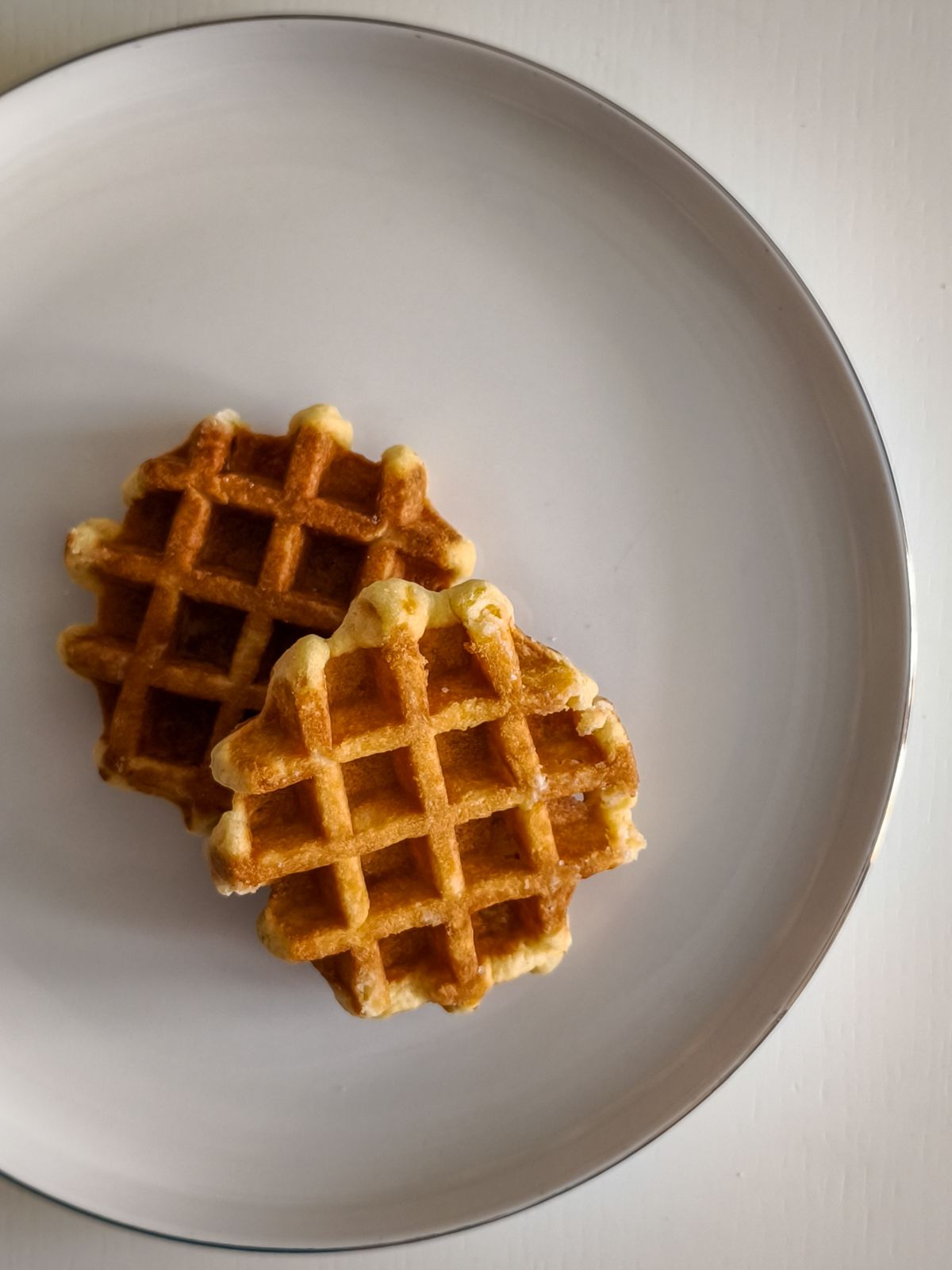
Fastest but Softest: Reheat Waffles in the Microwave
The microwave can make a waffle hot quickly, but it does not restore a dry crust. Food Network warns that fully microwaving a frozen waffle can leave it soft and then oddly tough or chewy. Pantry & Larder found the microwave more useful for a stale waffle than for recreating crispness.
When the microwave is your only option, use a short burst, check and eat immediately. Long heating increases the risk of a rubbery texture as the waffle cools.
The two-appliance rescue method
For a very thick frozen waffle, briefly microwave it only until the center begins to lose its frozen hardness, then finish it in a toaster or toaster oven. Food Network recommends this basic sequence. The microwave warms the interior; dry heat restores the exterior.
How to Reheat Frozen Waffles
You usually do not need to thaw frozen waffles. Going directly from freezer to toaster, toaster oven, oven or air fryer keeps the workflow simple and avoids a soft thawed waffle sitting at room temperature.
| Frozen waffle | Best method | Starting approach |
|---|---|---|
| Thin commercial waffle | Toaster | Low-to-medium cycle; repeat if needed |
| Homemade standard waffle | Toaster or toaster oven | Heat until center is hot and exterior crisp |
| Thick Belgian waffle | Toaster oven, oven or air fryer | Moderate heat; check center before adding more browning |
| Broken waffle pieces | Toaster oven or air fryer | Single layer so pieces cannot fall into toaster slots |
| Whole family batch | Oven | 350°F, single layer, roughly 7–12 minutes depending on thickness |
Should you thaw waffles first?
Thaw only when a recipe or appliance specifically requires it. Thawing introduces a separate waiting period and can allow condensation to soften the surface. Direct dry heat is usually simpler.
How to Reheat Belgian Waffles Without Burning the Outside
The defining problem with a Belgian waffle is geometry. Deep pockets and a thick center require more internal heating than a thin standard waffle.
- Prefer a toaster oven, oven or air fryer over a narrow upright toaster.
- Use moderate rather than maximum heat.
- Check the center, not only the edge color.
- Lower the heat if the surface darkens before the middle is hot.
- For several Belgian waffles, use an oven so each one lies flat in a single layer.
Food Network's frozen-waffle guide reflects the thickness difference by giving a longer oven time for Belgian waffles than for flat waffles. That is the correct principle even when your exact temperature and appliance differ.
How to Reheat Homemade Waffles vs Store-Bought Waffles
Homemade waffles
Thickness, fat, sugar and moisture vary widely. Start conservatively and record the method that works with your recipe.
Commercial frozen waffles
They are designed for reheating and often have package directions. Use those instructions before a generic online guide.
High-sugar waffles
They brown quickly. Use lower heat and watch for scorching before the center warms.
Very lean waffles
They can dry rapidly in an air fryer or long oven cycle. Choose shorter reheating and serve immediately.
Waffle Reheating Troubleshooting
| Problem | Likely reason | Fix now or next time |
|---|---|---|
| Outside burnt, center cold | Heat too high for waffle thickness | Use a toaster oven or lower oven/air-fryer temperature |
| Soft and limp | Microwave, covered storage or stacked reheating | Finish briefly with dry heat; keep in one layer |
| Dry and hard | Too long in air fryer/oven | Shorten reheating; consider skillet with a little butter |
| Uneven temperature | Overlap, inconsistent appliance heat or thick center | Use one layer; rotate or flip if the appliance has hot spots |
| Waffle sticks to tray | Sugary residue or exposed topping | Use a clean rack/tray and reheat waffles plain |
| Crisp at first, soft on plate | Steam trapped after reheating | Serve immediately; do not cover or stack |
| Chewy after microwave | Overheated moist crumb | Use shorter microwave burst and finish in toaster |
How to Keep Reheated Waffles Crispy Until Everyone Eats
Reheating and holding are separate jobs. A waffle can leave the toaster crisp and become soft while waiting under foil.
- Preheat a low oven before reheating the first waffle if you need to hold a batch.
- Place finished waffles directly on an oven rack or on a wire rack over a tray.
- Keep them in one layer whenever space permits.
- Do not cover them.
- Add syrup, fruit and cream only at the table.
If this is a frequent problem, link to the site's dedicated guide on keeping waffles crispy; this page should focus on reheating, while the holding guide can cover timing for a full brunch batch.
Can You Reheat Waffles More Than Once?
Repeated cooling and reheating degrades texture and makes temperature control less predictable. Store waffles in portions so you can remove only what you need.
For food safety, refrigerate cooked waffles promptly when they contain perishable ingredients or toppings, and avoid leaving them at room temperature for extended periods. Plain waffles are lower risk than waffles covered with dairy, eggs or meat, but storage conditions still matter.
The more useful quality rule is simple: reheat one portion once, then eat it. Do not reheat the entire batch every morning.
Best Method by Priority
| Your priority | Choose | Why |
|---|---|---|
| Fastest crisp waffle | Toaster | Direct heat and minimal preheating |
| Best for several waffles | Oven | Capacity and even single-layer heating |
| Best for thick waffle, small batch | Air fryer or toaster oven | Convection plus better fit than toaster slots |
| Richest result | Skillet with butter | Adds browning and fat |
| Fastest hot result regardless of crust | Microwave | Rapid internal heating |
| Best for a very dry waffle | Skillet or brief microwave + toaster | Restores warmth without prolonged dry heat |
A Simple Freezer-to-Plate Workflow
Store waffles individually
Freeze them flat before stacking so you can remove a single portion without thawing the batch.
Choose the appliance by thickness
Thin waffle: toaster. Thick waffle: toaster oven, oven or air fryer.
Start conservatively
Use moderate heat and check early. Add time only as needed.
Serve without a holding cover
Keep steam away from the crisp grid and add moist toppings last.
Frequently Asked Questions
What is the best way to reheat waffles?
For one or two thin waffles, a toaster is usually the fastest way to restore a crisp surface. Use an oven for a large batch, an air fryer for a few thick waffles, and a toaster oven when the waffles do not fit safely in an upright toaster.
How do you reheat waffles without making them soggy?
Use dry heat, keep the waffles in a single layer and avoid covering or stacking them while hot. A toaster, toaster oven, oven or air fryer removes surface moisture more effectively than a microwave.
Can you reheat frozen waffles without thawing them?
Yes. Frozen waffles can generally go directly into a toaster, toaster oven, oven or air fryer. Thick Belgian waffles may need gentler heat or more time so the center warms before the outside becomes too dark.
How long do you reheat waffles in an air fryer?
At about 350°F (175°C), refrigerated waffles often need around two to three minutes and frozen or thick Belgian waffles around three to five minutes. Check early because air fryers vary and can dry thin waffles quickly.
Can you microwave waffles?
Yes, but the microwave softens the crust and can make waffles chewy as they cool. For speed, use a brief microwave warm-up followed by a toaster or toaster oven when possible.
How do you reheat waffles in the oven?
Arrange them in a single layer and heat at about 350°F (175°C) for roughly five to ten minutes. Frozen or thick Belgian waffles may take longer. Leave them uncovered for a crisper surface.
Can you reheat waffles in a waffle maker?
Yes, especially if the waffle fits the original grid, but it requires preheating and cleanup. Use gentle pressure and avoid forcing a cold waffle into a shape that no longer aligns with the plates.
Bottom Line
The toaster is the best default for one or two thin waffles, while the oven is the best choice for a batch. Use an air fryer or toaster oven for thick Belgian waffles that need more center heating and do not fit comfortably in toaster slots.
Whatever appliance you choose, keep the waffles in one layer, use moderate heat first and add toppings only after reheating. The two most common failures—burnt outside with a cold center and a soft, soggy surface—both come from using the wrong heat pattern for the waffle's thickness.