Pancake troubleshooting
Why Do My Pancakes Fall Apart?
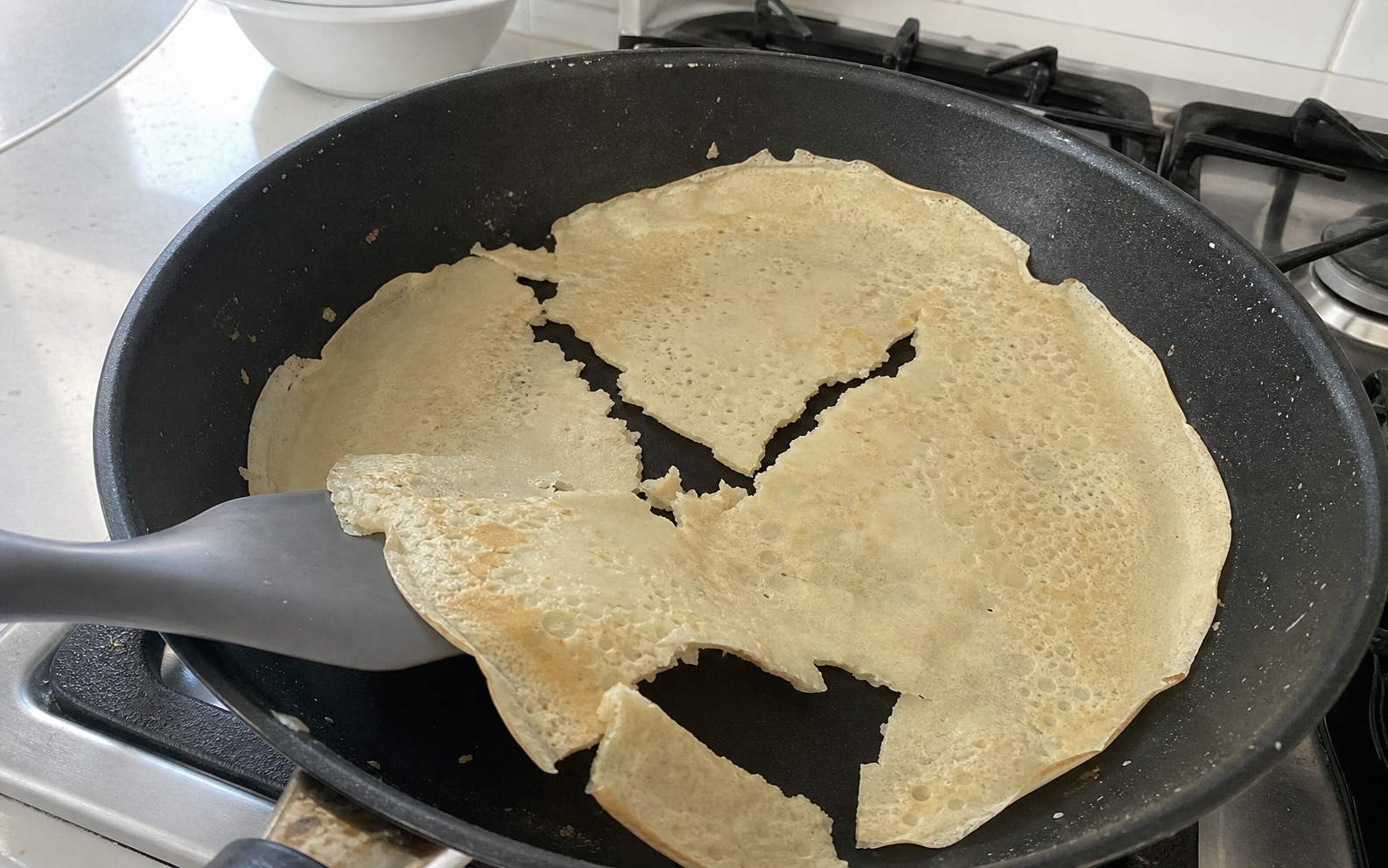
If your pancakes fall apart when you flip them, do not change the batter first. Watch the exact moment they fail. A pancake that sticks and tears needs a different fix from one that releases cleanly but folds in mid-flip, and both are different from a pancake that crumbles after it is fully cooked.
Quick answer
Use the break point as your diagnosis. If the underside is still attached to the pan, troubleshoot sticking. If the pancake releases but bends, folds or tears while turning, wait longer before flipping and support it with a broad spatula. If the batter spreads unusually thin, verify the recipe measurements and substitutions before adding flour or egg.
Diagnose the Problem Before You Touch the Batter
“My pancakes fall apart†describes several different failures. Start with the one you can actually observe. This avoids a common troubleshooting mistake: changing flour, egg, liquid and heat at the same time, then having no idea which variable mattered.
| What you see | Most useful first suspect | First comparison to make |
|---|---|---|
| The spatula lifts one part, but the bottom stays stuck | Release / sticking | Let it cook a little longer and confirm the pan releases cleanly before lifting |
| It releases, then folds over the spatula | Timing or support | Wait for stronger turning cues and use a broader turner |
| It tears through the soft center during the flip | First side not set enough | Give the next pancake more time before turning |
| It spreads very thin and feels fragile from the start | Recipe ratio or measurement | Recheck liquid, flour and substitutions against the recipe |
| It cooks intact but crumbles on the plate | Recipe-specific structure | Review the formula rather than treating it as a flipping problem |
This decision-first approach is especially useful because reliable pancake recipes themselves vary. For example, Betty Crocker publishes a self-rising pancake recipe whose batter is explicitly described as very thin, so “thin batter†by itself is not proof that a pancake recipe is wrong.
7 Reasons Pancakes Can Fall Apart
1. You are flipping before the first side has set
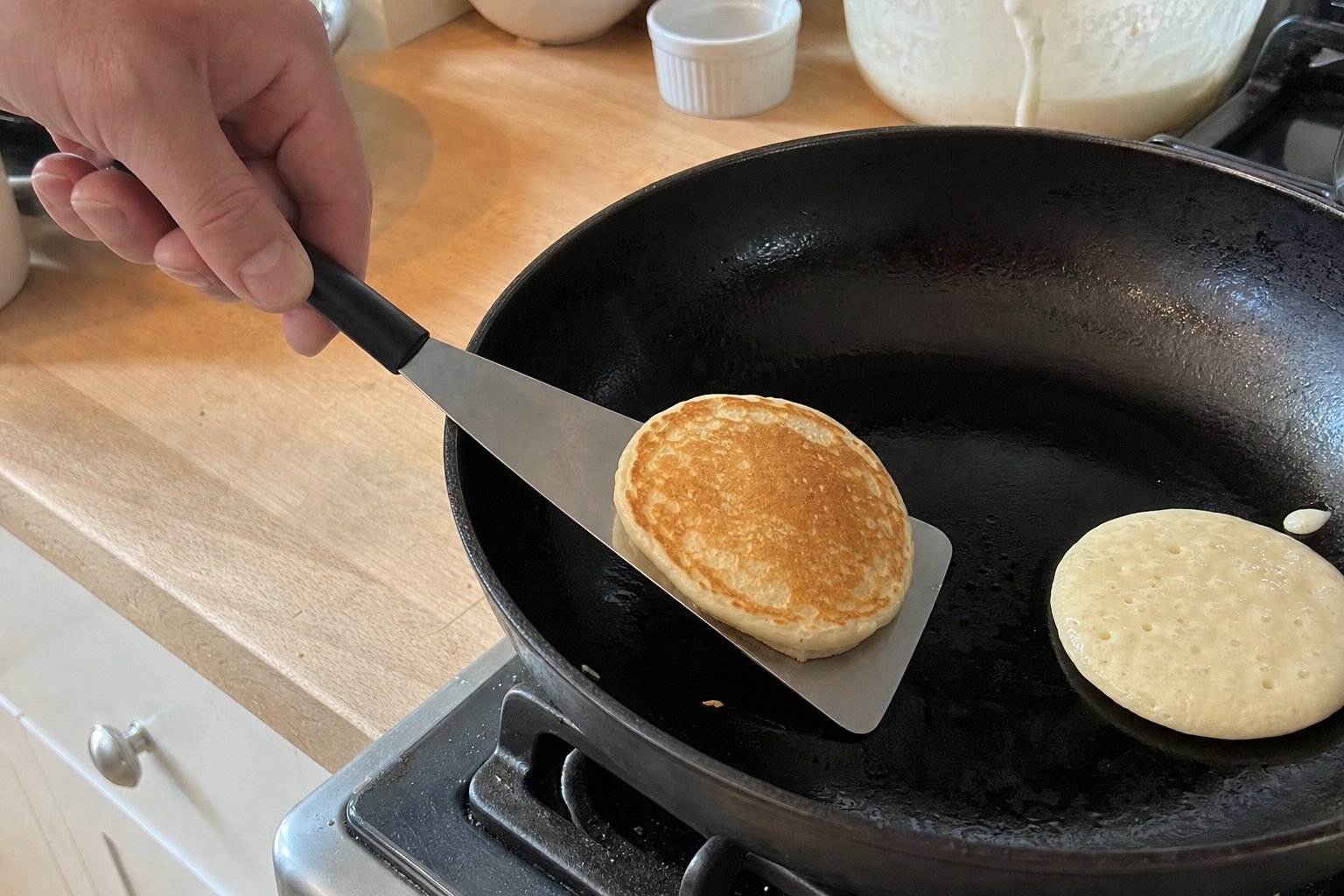
This is the first thing to check when the pancake releases from the pan but cannot support its own weight during the turn. Oregon State University Extension's pancake instructions use a bubbly top and edges beginning to look dry as turning cues, then call for a quick flip with a broad spatula. That is a useful recipe-based model for what “ready to turn†looks like.
2. The pancake is sticking, not simply breaking
If the underside remains attached while the upper portion moves, the tear is a consequence of poor release. Treat that as a pan-and-release problem before reformulating the batter. A pancake that is structurally fine can still rip if half of it is anchored to the skillet.
3. The spatula supports too little of the pancake
A narrow utensil creates a long unsupported section. That matters more with a large, soft or delicate pancake. Slide a broad turner far enough underneath that most of the pancake moves as one piece.
4. The flip is slow and hesitant
Once the pancake is supported and ready, repeated lifting and repositioning gives it more opportunities to fold. The Oregon State guidance specifically uses a quick flip and recommends turning only once.
5. The pancake is simply too large for your current technique
Oversized pancakes are harder to support and require a larger stable area before turning. If the first one breaks, make the next pancake smaller while leaving the batter unchanged. That creates a clean comparison.
6. The batter is unexpectedly thin for that recipe
Too much liquid or a measuring error can produce a pancake that spreads farther and becomes difficult to handle. But compare the batter with the specific recipe, not with a universal thickness rule. Some legitimate pancake recipes are designed around thinner batters.
7. A substitution changed the structure
If the problem started only after replacing flour, egg or another major ingredient, the substitution deserves attention. This is especially important with gluten-free, egg-free, high-fruit or high-moisture batters, where a standard wheat-pancake fix may not transfer cleanly.
How to Flip a Pancake Without Tearing It
Watch the pancake, not only the clock
Use the visual cues specified by your recipe. In the Oregon State Extension example, the top becomes bubbly and the edges begin to look dry before turning.
Check release before committing
Slide the turner under an edge. If the underside is still gripping the pan, forcing the flip can convert a sticking problem into a torn pancake.
Get the spatula well underneath
Support the center of mass rather than balancing most of the pancake beyond the utensil.
Turn once, in one controlled motion
A clean flip is easier on a fragile pancake than a sequence of half-lifts. After landing, let the second side cook instead of repeatedly turning it.
Is It the Batter or the Flipping Technique?
Run one simple comparison before changing the recipe. Make the next pancake from the same batter, but make it slightly smaller, wait for clear turning cues and use a broad spatula. If it stays intact, the result points toward handling or timing as the practical fix for that batch.
If it still fails in the same way, then inspect the formula: were the liquid and flour measured correctly? Was an egg omitted? Was all-purpose flour replaced with a gluten-free, nut or alternative flour? Did you add a large amount of fruit or another wet ingredient?
- only the first pancake failed;
- the failed pancake visibly stuck to the pan;
- you flipped while the top was still very fluid;
- the pancake was much larger than usual;
- you have not rechecked the recipe measurements.
Can the Wrong Heat Make Pancakes Fall Apart?
Yes, indirectly. If the cooking surface is too cool, the pancake may take longer to set and release; if it is too hot, the underside can color while the upper structure is still very soft. This is why color alone is a weak flipping cue.
Betty Crocker's self-rising pancake method uses medium heat or a 350°F griddle and waits until the pancakes are bubbly, puffed and slightly dry around the edges. Oregon State's pumpkin-pancake method uses its own recipe-specific temperature and the same general family of visual cues. The useful lesson is not one magic temperature: it is to pair appropriate heat with visible signs that the pancake has set enough to turn.
Falling Apart vs. Sticking vs. Raw in the Middle
These problems can look similar during a failed flip, but they lead to different fixes.
Sticking
Part of the cooked surface remains attached to the pan. Diagnose pan release and heat first.
Falling apart
The pancake releases but cannot stay intact during handling. Diagnose timing, support, size and recipe changes.
Raw center
The interior is visibly wet or batter-like. This is an undercooking problem, even if the exterior is brown.
Gummy texture
The center is cooked-looking but tacky or rubbery. Mixing and recipe balance become more relevant.
When the Standard Advice Does Not Apply Cleanly
Some pancakes are intentionally more delicate. Gluten-free batters, egg-free formulas, banana-heavy pancakes, ricotta pancakes and Japanese soufflé-style pancakes do not all behave like a basic all-purpose-flour pancake. If you are using one of these recipes, troubleshoot inside that recipe's intended method before borrowing a fix from a conventional pancake.
For example, Oregon State Extension publishes an egg-free pancake recipe that still instructs cooks to use a broad spatula and a quick single flip. That is a useful reminder that “it broke, therefore it needs another egg†is not a safe universal diagnosis.
How to Rescue the Batch You Already Mixed
Do not discard the bowl after one failed pancake. Use the next pancake as a controlled test:
- Keep the batter unchanged.
- Make the pancake a little smaller.
- Allow the first side to reach the recipe's visual turning cues.
- Confirm that it releases from the pan.
- Slide a broad spatula well underneath.
- Flip once, decisively.
If that pancake works, continue the batch with the corrected technique. If it fails in exactly the same way, recheck measurements and substitutions. If the symptom changes—for example, it now releases but is visibly raw inside—switch to the troubleshooting path for that new symptom rather than continuing to add ingredients.
A 30-Second Decision Checklist
| Question | If yes | What to do next |
|---|---|---|
| Is the pancake still attached to the pan? | Likely release problem | Troubleshoot sticking before batter |
| Is the top still very wet when you flip? | Likely too early | Wait for recipe-specific set cues |
| Does it fold over a narrow spatula? | Support may be insufficient | Use a broader turner |
| Did you change a major ingredient? | Formula may have changed | Compare with original recipe |
| Is the middle visibly raw after cooking? | Different problem | Troubleshoot undercooking |
What This Guide Can—and Cannot—Tell You
This guide is a diagnostic framework based on published pancake methods and observable failure points; it is not a report of a controlled kitchen test. The strongest technique cues used here come from published recipes from Oregon State University Extension, MedlinePlus and Betty Crocker. Your own recipe remains the controlling reference for batter thickness, portion size and cooking method.
Frequently Asked Questions
Why do my pancakes fall apart when I flip them?
First check whether you are flipping before the first side has set. If the pancake releases from the pan but folds or tears during the turn, wait for the recipe's visual turning cues, support more of it with a broad spatula and use one quick controlled flip.
Why does my pancake tear when I slide the spatula underneath?
If part of the underside remains attached to the pan, treat it as a sticking problem. If it releases cleanly but the soft edge tears, give the pancake more time before turning and support more of it with the spatula.
Should I add another egg if my pancakes fall apart?
Not automatically. Breakage alone does not prove an egg or binder problem. Check the failure point, flipping timing, sticking, measurements and substitutions before changing the formula.
Can pancake batter be too thin to flip?
An unexpectedly thin batter can make a pancake more delicate, but batter thickness varies by recipe. Recheck the recipe and measurements before adding flour.
Why does my pancake fold instead of flipping?
If it releases cleanly, folding points more toward support, pancake size or turning technique. Use a broad spatula and one controlled flip after the first side has set.
Can I eat a pancake that broke apart?
Breakage is not a doneness test. Fully cooked broken pieces are still usable. If the interior contains visibly raw batter, treat that as an undercooking problem.
Bottom Line
Diagnose the break before you fix the batter. A stuck pancake, an early flip, an oversized pancake and a recipe-ratio problem can all produce a messy turn, but they do not need the same correction. Make one controlled change on the next pancake and let the result tell you where to go next.