Pancake troubleshooting
Why Do My Pancakes Have a White Ring Around the Edge?
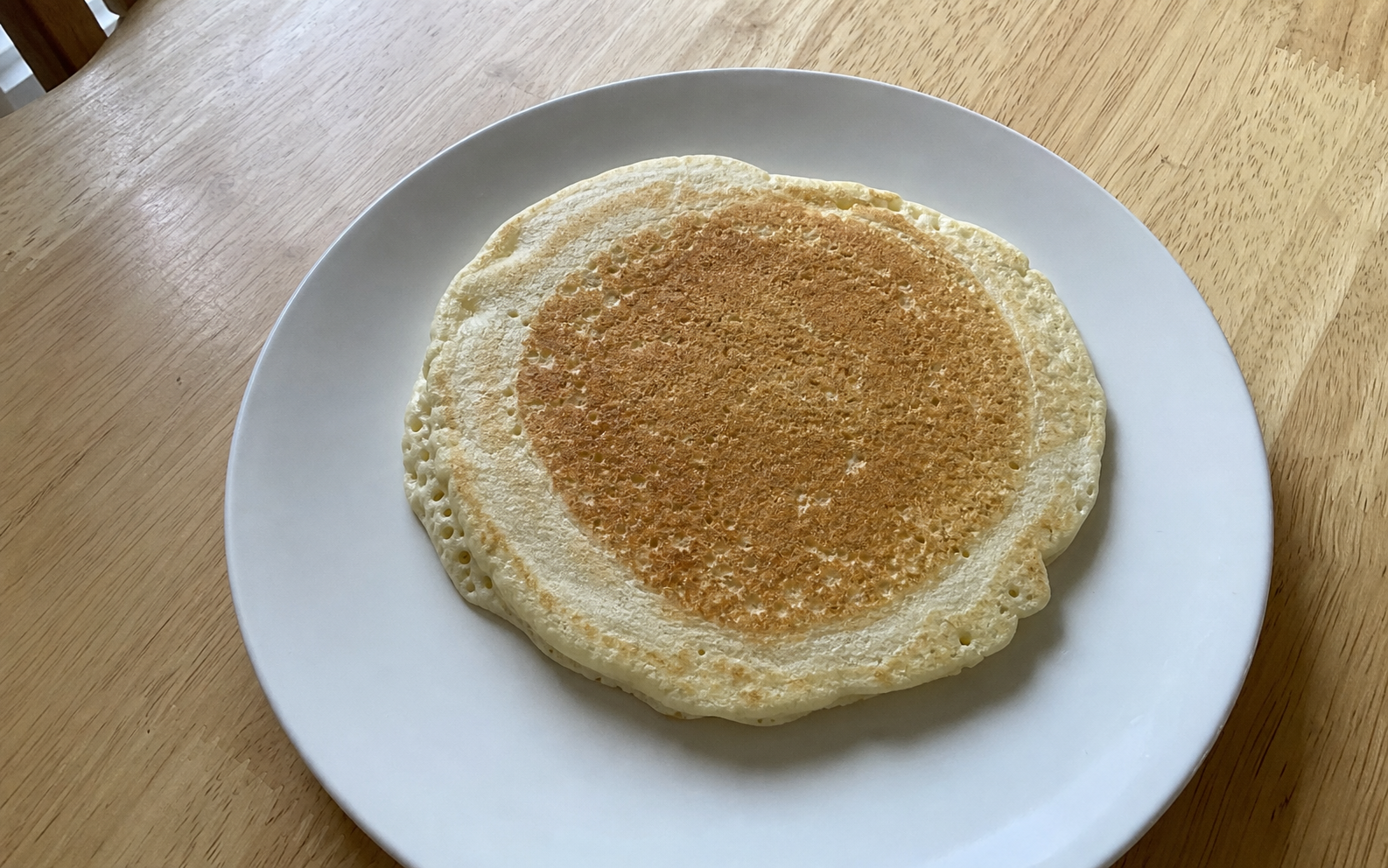
A pale or white ring around a pancake is usually a browning pattern, not proof that the pancake is raw. The center faces the hot pan directly, while the curved outer rim can stay lighter—especially on thicker pancakes. In fact, some professionally published blini recipes describe a small white ring around the edge as part of the finished appearance.
By Waffle Kitchen Editorial Team · Published August 3, 2026
Quick answer
If the pancake is cooked through and the pale ring is only around the side edge, you may not need to fix anything. A small white rim can simply be the portion of the pancake that never had the same flat contact with the pan as the top and bottom. If the ring is unusually wide, appears together with a wet center, or only started after you changed heat, batter thickness or pancake size, troubleshoot those variables instead.
Is a White Ring Around a Pancake Normal?
Sometimes, yes. A Los Angeles Times adaptation of Thomas Keller's Yukon Gold potato blini specifically describes the finished blini as evenly browned with a small ring of white around the edges. That is useful evidence because it shows that a pale rim can exist on a properly finished pancake-style food rather than automatically signaling failure.
Very thick Japanese soufflé pancakes make the distinction even clearer: their tall sidewalls can remain pale while the flat top and bottom brown. A gluten-free soufflé-pancake guide describes the style as browned on the top and bottom with white around the middle.
What Kind of White Ring Do You Have?
| Appearance | Most useful interpretation | What to check |
|---|---|---|
| Thin, even white line around a normal pancake | May simply be the sidewall | Check doneness; otherwise no fix may be needed |
| Wide white band on a very thick pancake | Side has little direct pan contact | Pancake thickness and style |
| White rim plus wet/raw center | Possible undercooking | Heat, size and cooking time |
| White ring only appears when pan is very hot | Center may be setting/browning before outer batter spreads and cooks similarly | Run a lower-heat comparison |
| One side of the ring is much wider | Uneven thickness or batter spread | Pouring position and pan level |
| Flat surface itself has a pale halo | Uneven contact/browning pattern | Pan surface, grease and heat distribution |
5 Reasons Pancakes Can Develop a White Ring
1. The side edge never touches the pan directly
A pancake is not a flat sheet. As it rises, it develops a sidewall between the browned bottom and the upper surface. That vertical area receives heat differently from the face pressed against the pan, so it can remain much lighter.
2. The pancake is thicker than usual
The taller the pancake, the more visible sidewall it has. This is why the effect can be particularly obvious on soufflé pancakes, which are intentionally much taller than conventional pancakes.
3. The pan is browning the center faster than the rest of the pancake develops
Anecdotal Japanese hotcake testing has reported a white ring when batter is poured onto a pan while it remains over the heat, while temporarily removing the pan before pouring produced more uniform browning. That is not a controlled scientific test, but it suggests a useful home diagnostic: compare one pancake at slightly gentler, more stable heat without changing the batter.
4. The batter is not spreading evenly
If one side of the pancake is taller, that side can show a wider pale band. Pouring consistently and using a level pan helps separate a shape problem from a heat problem.
5. The pancake is actually undercooked
The ring itself does not prove this, but a broad pale band combined with a gummy or wet interior changes the diagnosis. In that case, focus on cooking the center properly rather than trying to cosmetically brown the edge.
How to Reduce the White Ring on Pancakes
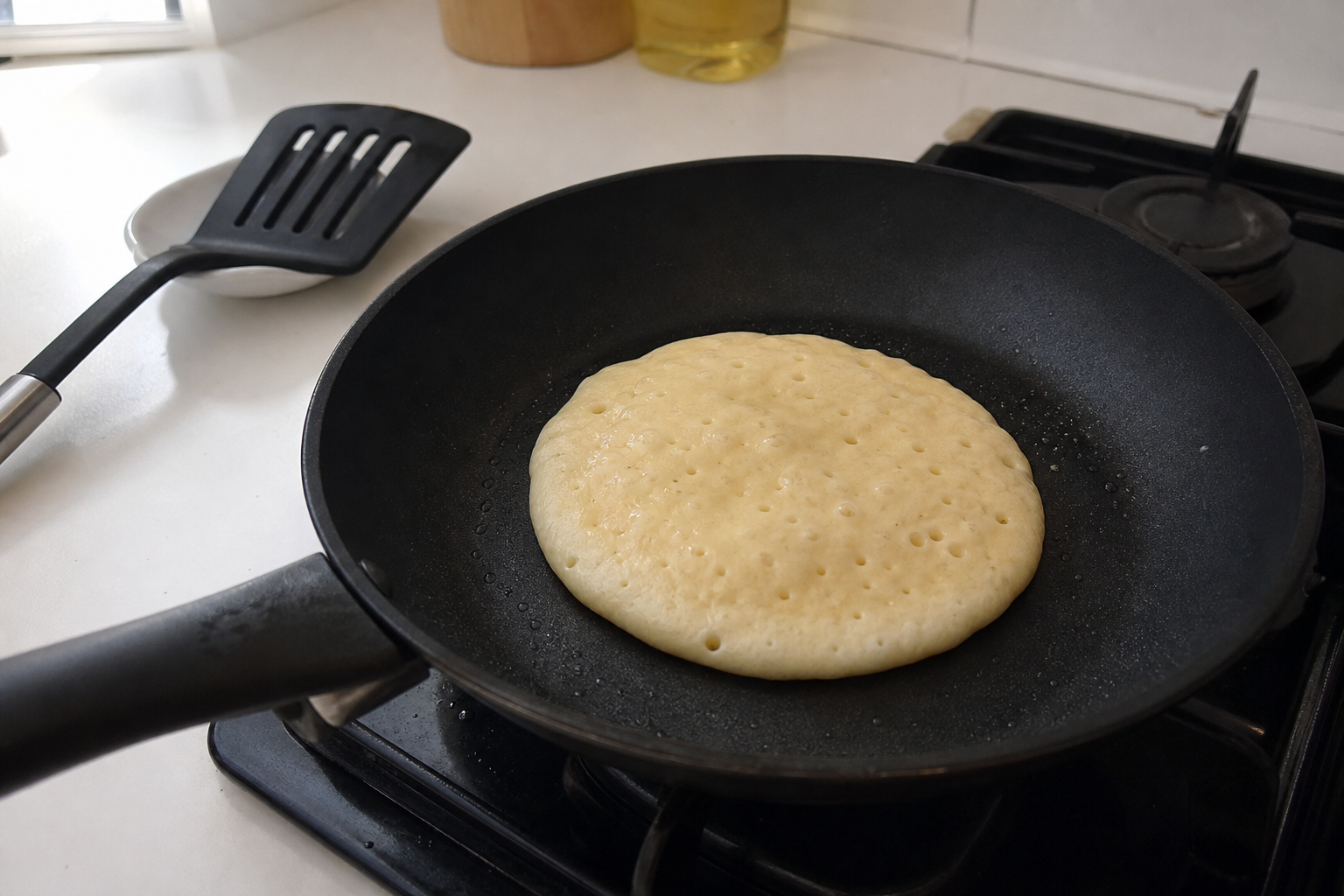
If the pancake is fully cooked and you simply prefer a more evenly browned appearance, change technique conservatively. Do not rewrite the batter before establishing whether heat or pancake thickness is responsible.
Keep the recipe unchanged
Use the same batter so you can actually identify which cooking change affects the ring.
Make one slightly smaller pancake
A smaller diameter is easier to control and lets you observe whether thickness is contributing.
Use moderate, stable heat
If the center darkens quickly while the side remains stark white, try a slightly gentler setting on the next pancake.
Pour consistently
Pour into the same area of a level pan and allow the batter to form its shape naturally.
Judge the interior separately
Do not extend cooking indefinitely just to erase a cosmetic white line if the pancake is already properly cooked.
Does a White Edge Mean My Pancakes Are Raw?
No. Color alone cannot establish doneness. A narrow pale sidewall can be present on a cooked pancake, and published blini instructions explicitly accept a small white ring in the finished product.
Look instead at the interior. A properly cooked conventional pancake should not have liquid batter in the center. If the inside is wet or gummy, then you have an undercooking problem regardless of whether a white ring is visible.
White edge + cooked center
Primarily an appearance issue.
White edge + wet center
Treat as a doneness problem.
White edge + burnt faces
Heat may be too aggressive for the pancake thickness.
White edge + tall pancake
May be normal for the style.
Why Do Japanese Soufflé Pancakes Have White Sides?
Soufflé pancakes exaggerate the same geometry. They are tall, so only the bottom—and later the opposite face—gets the same direct pan contact as a conventional pancake. The vertical middle remains comparatively pale. Some soufflé-pancake guides actually describe a browned top and bottom with a white middle as characteristic of the style.
So if you arrived here because your tall Japanese pancakes have a neat white band around the middle, that visual alone is not necessarily something to correct. Evaluate structure and doneness separately.
Why Does the White Ring Change Between Pancakes?
If the first pancake has a different ring from the third or fourth, the pan may be changing temperature between batches. This is especially useful diagnostically because the batter is largely the same while the cooking surface is the moving variable.
- Use the same measured amount of batter for three pancakes.
- Keep their diameter as similar as possible.
- Do not change the recipe.
- Photograph the edge of each pancake.
- If the ring changes while thickness stays similar, investigate pan temperature and recovery.
White Ring vs. Pale Pancake: Not the Same Problem
A pancake with a brown center and a narrow pale edge is different from a pancake whose entire face refuses to brown. The first is mainly about edge geometry and local heat exposure. The second points toward overall browning conditions such as pan temperature, cooking surface or recipe composition.
This distinction matters for SEO troubleshooting too: “white ring around pancakeâ€, “pancake white around edges†and “why are pancake edges pale†describe a localized visual symptom, not simply “pancakes not browning.â€
What This Guide Can and Cannot Establish
This is a source-based diagnostic guide, not a controlled kitchen experiment. Published recipes demonstrate that a white rim can be normal in some pancake styles, but there is limited authoritative research specifically explaining the white-ring pattern in standard pancakes. The heat-related explanation should therefore be treated as a practical diagnostic hypothesis: change one variable at a time and observe whether the ring changes.
Frequently Asked Questions
Why are my pancakes white around the edges?
A narrow white edge may simply be the pancake's sidewall, which does not have the same direct contact with the pan as the browned face. If the center is cooked, it may be cosmetic.
Is a white ring around pancakes normal?
It can be. Published blini instructions even describe a small white ring around the edge as part of the finished appearance.
Does a white edge mean pancakes are undercooked?
Not by itself. Check the center. A wet or gummy interior indicates a doneness issue; a cooked center with a thin pale sidewall does not.
Why do Japanese pancakes have white sides?
Their tall sidewalls receive less direct pan contact than their top and bottom surfaces. A pale middle band can be characteristic of the style.
How do I get pancakes evenly brown to the edges?
Use stable moderate heat, consistent portions and even batter placement. If the remaining white line is only the vertical side of a fully cooked pancake, completely eliminating it may not be necessary.
Why is the white ring wider on one side?
Check whether that side of the pancake is thicker, whether the pan is level and whether the batter spread unevenly before setting.
Bottom Line
A thin white ring around a fully cooked pancake is usually more of a browning pattern than a failure. Thick pancakes naturally expose a larger pale sidewall. If the band is unusually wide, pair the visual clue with other symptoms: wet center points to doneness, burnt faces point to aggressive heat, and an uneven ring points to thickness or batter distribution.